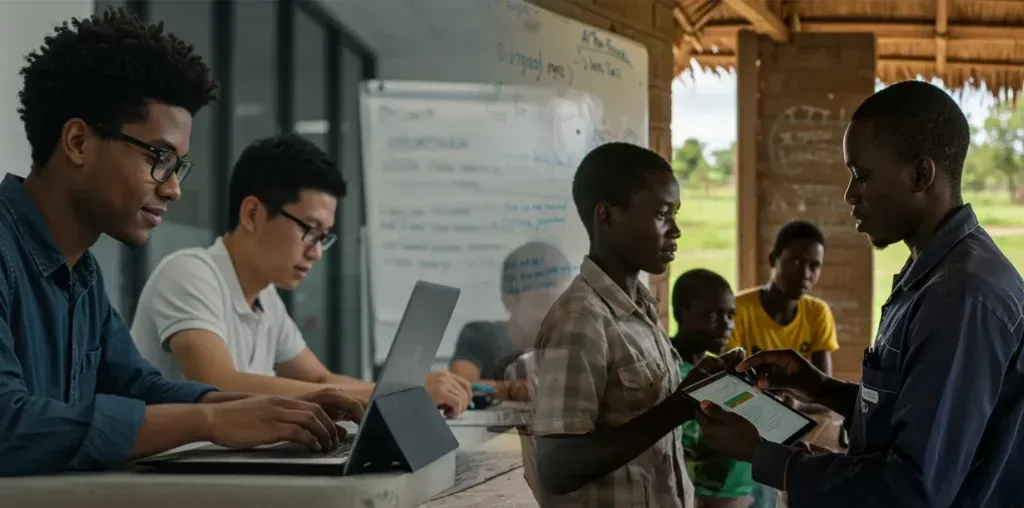
How AI Is Closing the Digital Divide in Underserved Communities
For decades, access to technology has drawn a line between the connected and the disconnected, between opportunity and limitation. This gap, known as the digital divide, has left millions of people behind. But now, something powerful is changing the landscape: Artificial Intelligence (AI).
At Jepnest Innovation AI Foundation Corp, we believe that AI should not be a privilege for the few but a bridge to opportunity for all. Our mission to educate, implement, and develop AI technology extends directly into underserved communities, where innovation is not just welcome, but urgently needed.
Let’s explore how AI is breaking barriers, building equity, and reshaping what’s possible for those who’ve been left out of the digital revolution.
The Digital Divide: More Than Just a Connectivity Issue
When we talk about the digital divide, it’s not only about internet access. It’s about unequal access to education, healthcare, job opportunities, digital skills, and the tools necessary to participate fully in a tech-driven society.
In rural areas, inner cities, and developing regions, millions of people lack access to computers, quality internet, and basic tech literacy. This affects everything from remote learning to applying for jobs and accessing essential services.
But AI is changing the equation, offering innovative, scalable solutions where traditional systems fall short.
AI in the Classroom: Bringing Education to Every Zip Code
One of the most transformative ways AI is closing the divide is through education. In areas where qualified teachers and educational infrastructure are scarce, AI-powered learning tools are stepping in to fill the gap.
Intelligent tutoring systems can adapt lessons in real-time to suit each student’s learning pace, language, and comprehension level. Students who previously struggled with limited resources now gain access to personalized education on a smartphone or tablet.
And for teachers? AI assists in grading, lesson planning, and student tracking, freeing them to focus on mentorship and creativity rather than administrative work.
At Jepnest, we’re committed to helping communities adopt AI-driven educational tools that make learning equitable, inclusive, and lifelong.
AI-Powered Healthcare: A Lifeline in Low-Access Areas
In underserved communities, access to healthcare is often limited by geography, infrastructure, and cost. AI is emerging as a quiet revolution in telemedicine and diagnostics, offering support where doctors are few and hospitals are distant.
Chatbots and AI apps can now conduct initial health assessments, monitor symptoms, and even detect diseases using just a smartphone camera or wearable device. Machine learning algorithms can process patient data to recommend treatments and predict health risks, delivering care faster and more efficiently.
In regions where medical professionals are overwhelmed or under-resourced, these tools don’t replace human care, they extend it. AI can be the first line of support, helping people make informed decisions about their health.
Workforce Development: New Skills for a New Era
Technology often creates fear in underserved communities, fear that jobs will disappear and automation will widen the gap. But with the right support, AI becomes a job creator, not a job stealer.
Through AI-powered job training platforms and career development tools, people in marginalized communities are gaining access to:
Online courses tailored to in-demand tech skills
AI-based résumé builders and interview simulators
Real-time job matching using machine learning algorithms
Even for those without formal education, AI is opening doors to remote work, gig economy platforms, and entrepreneurship. All it takes is a smartphone and an opportunity, and we’re working to deliver both.
AI for Language, Inclusion, and Access
Many underserved communities are also linguistically and culturally diverse. AI tools such as natural language processing (NLP) and machine translation are breaking down communication barriers like never before.
Voice-enabled assistants now understand multiple languages and dialects. Translation tools empower non-native speakers to participate in digital spaces. For people with disabilities, AI is creating new modes of access through speech-to-text, image recognition, and assistive devices.
This level of inclusive design means no one is left behind, regardless of language, ability, or location.
The Role of Local Engagement and Ethical Design
Closing the digital divide with AI isn’t just about deploying technology; it’s about doing it with and for the communities it serves.
At Jepnest Innovation AI Foundation Corp, we emphasize community-led innovation. We listen first. We partner with local educators, entrepreneurs, and organizations to understand what’s needed and then co-create AI solutions that are culturally relevant, ethical, and sustainable.
Privacy, data ownership, and transparency are critical. Underserved communities must not become experimental grounds for unchecked tech. That’s why we advocate for ethical AI that empowers users without exploiting them.
A Bridge to the Future, Not Just the Internet
The digital divide may seem like a deep canyon, but with AI, we’re building bridges. Not just to the internet, but to education, healthcare, jobs, dignity, and hope.
These aren’t futuristic dreams. They’re happening right now, in rural schools with AI tutors, in city clinics powered by predictive diagnostics, and in neighborhoods gaining access to tech skills they were once denied.
And this is just the beginning.
Technology That Includes Everyone
AI’s greatest power lies not in its complexity, but in its potential to serve. To uplift. To equalize. It can’t erase every inequality, but it can level the playing field in ways no other technology has before.
At Jepnest Innovation AI Foundation Corp, we’re on a mission to make sure AI doesn’t just live in labs or boardrooms, but in classrooms, clinics, and communities where it’s needed most.
Because the future doesn’t belong to the few.
It belongs to everyone.
